
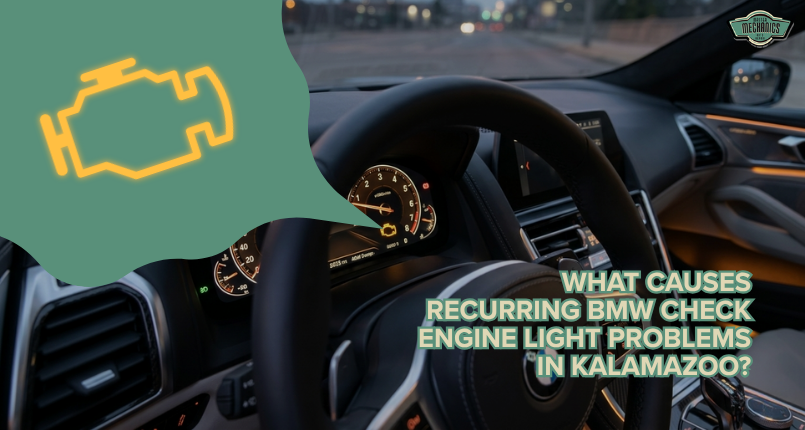
There’s a specific frustration that comes with clearing a BMW check engine light, driving for a week, and watching it come right back on. It’s one of the most common complaints Kalamazoo BMW owners bring to our shop — and it almost always means the root cause was never properly identified in the first place. A cleared code is not a fixed problem. On BMW’s sophisticated engine management architecture, a check engine light that keeps returning is telling you that something is consistently wrong, and the only way to make it stay off is to find and fix the actual fault.
Master Mechanics Auto Repair is Kalamazoo’s dedicated European and import auto specialist, serving BMW owners across Kalamazoo, Portage, and Battle Creek from our East Kilgore Road location. If your BMW’s check engine light won’t stay off, here’s a comprehensive breakdown of the most common recurring causes — and what it takes to resolve them.
Why BMW Check Engine Lights Recur After Being Cleared
The check engine light on a BMW — officially called the malfunction indicator lamp (MIL) — illuminates when the engine management system stores a fault code indicating an issue outside normal operating parameters. When a shop clears the code without repairing the underlying fault, the light goes off temporarily. The vehicle then runs its OBD-II readiness monitors, the same fault condition is detected again, and the light returns — sometimes within a single drive cycle, sometimes after a few days.
On BMW’s DME (Digital Motor Electronics) system, fault codes contain far more diagnostic information than the simple P-codes a basic scanner reads. BMW-specific fault codes include freeze frame data, fault frequency counters, environmental conditions at the time of fault, and readiness monitor status — all of which are essential for identifying why a fault keeps recurring. A shop that reads only the generic OBD-II code and clears it is operating with a fraction of the diagnostic information BMW’s system provides.
The Most Common Recurring BMW Check Engine Light Causes in Kalamazoo
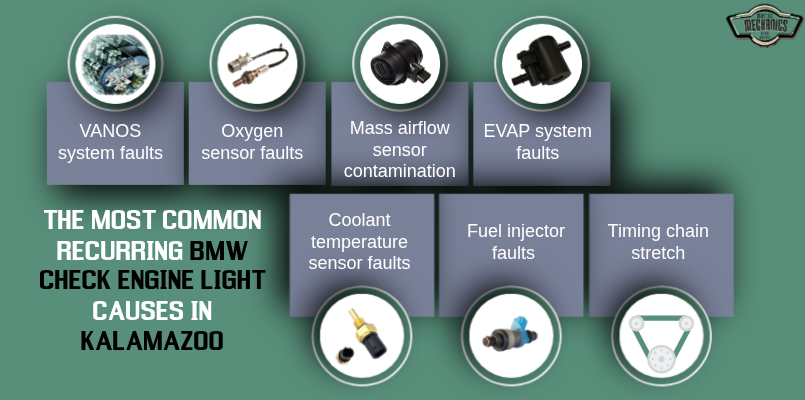
- VANOS system faults are among the most frequent causes of the check engine light on BMW’s inline-six engines — the N52, N54, N55, and S55 found in the 3 Series, 5 Series, and M models. VANOS is BMW’s variable valve timing system, which adjusts camshaft timing continuously based on engine load and RPM. VANOS solenoid failures, oil pressure delivery faults, and camshaft position sensor errors produce timing-related fault codes that return reliably after clearing. In Kalamazoo’s cold winters, VANOS faults are particularly common because the system depends on proper oil viscosity, and cold, thick oil delays VANOS response at startup, generating codes that persist even after the oil warms.
- Oxygen sensor faults — specifically the pre-catalyst and post-catalyst oxygen sensors — are the most statistically common recurring check engine cause on any BMW platform. O2 sensors degrade over time and produce incorrect feedback on the fuel mixture that the DME registers as fuel trim faults. A sensor that’s failing intermittently will clear and return repeatedly as it passes the readiness monitor on warm days and fails it on cold ones. Michigan winters are particularly hard on O2 sensor response time — cold sensors take longer to reach operating temperature, creating the lean/rich cycling that generates codes.
- Mass airflow sensor contamination — as covered in Blog 14 regarding Porsche — a contaminated MAF sensor produces erratic airflow readings that trigger lean-fuel mixture codes (P0171, P0174) on BMW’s inline-six engines. These codes recur after clearing because the contaminated sensor continues to produce incorrect data. Kalamazoo’s combination of seasonal pollen, road dust, and the industrial particulate from the manufacturing corridor near East Kilgore Road contributes to MAF contamination rates higher than those in cleaner-air markets.
- EVAP system faults — BMW’s evaporative emission system, which captures fuel vapors from the tank and routes them through a charcoal canister for combustion, can develop a range of recurring faults. The purge valve sticks, the canister becomes saturated, the leak detection pump fails, or a fuel cap seal degrades. Kalamazoo’s temperature swings between Michigan winters and summers significantly stress the rubber components in the EVAP system. EVAP faults are notorious for returning after clearing because the system runs its leak test under specific drive-cycle conditions that may require several trips to complete.
- Coolant temperature sensor faults — BMW coolant temperature sensors degrade and produce incorrect readings, resulting in fuel mixture and emissions faults. A sensor that reads low tells the DME the engine is colder than it actually is, causing the system to over-fuel unnecessarily. In Kalamazoo’s cold winters, a marginally failing temperature sensor may perform adequately in warm weather but fail the readiness monitor consistently during cold starts on Michigan mornings.
- Fuel injector faults — on BMW’s N54 and N55 turbocharged engines, injector deposits and wear can trigger misfire codes that recur. The N54’s high-pressure direct injectors are sensitive to fuel quality and deposit buildup. Kalamazoo’s E10 fuel blend and varying fuel quality across stations along the Kilgore Road corridor contribute to injector deposit formation, which generates recurring cylinder-specific misfire codes.
- Timing chain stretch — on BMW’s N47 diesel engines and certain N-series gasoline engines, timing chain guide wear allows the chain to stretch and develop slack. The DME detects a timing deviation and generates camshaft position fault codes that recur each time the vehicle is started until the timing chain is properly serviced. In Kalamazoo’s cold winters, a timing chain rattle on cold start is the acoustic companion to the fault code.
What Makes Kalamazoo’s Climate a Factor in Recurring BMW Faults
Michigan’s climate creates specific conditions that accelerate the failure modes most likely to generate recurring BMW check engine lights:
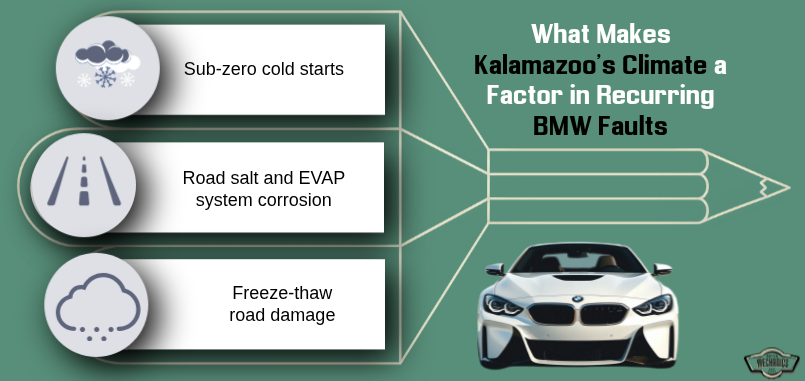
- Sub-zero cold starts — BMW engines in Kalamazoo experience cold start conditions several months per year, where oil viscosity is at maximum thickness, sensor response times are extended, and fuel atomization is degraded. Cold start conditions stress VANOS systems, oxygen sensors, MAF sensors, and fuel injectors simultaneously — creating a diagnostic environment where multiple marginal components can all fail readiness monitors on cold days while appearing to pass on warmer ones.
- Road salt and EVAP system corrosion — Michigan’s aggressive road salting creates a corrosive environment for the steel and rubber components of the EVAP system. Corroded EVAP line fittings and deteriorated purge valve rubber generate the small leaks that trigger recurring EVAP system fault codes. These are among the most difficult recurring faults to diagnose without BMW-specific diagnostic tooling capable of precisely measuring leak rates.
- Freeze-thaw road damage — Kalamazoo’s road network experiences significant pothole and surface deterioration each spring. The vibration from deteriorated road surfaces on East Kilgore Road, Gull Road, and the US-131 corridor works sensor connectors loose — creating intermittent connection faults that generate codes, clear temporarily, and return when vibration loosens the connection again.
How Master Mechanics Resolve Recurring BMW Check Engine Light Problems in Kalamazoo
Our approach to recurring BMW check engine lights starts with a BMW-compatible full system scan that reads the complete fault memory — not just the active fault code — including freeze frame data, fault frequency counters, and readiness monitor status. This gives us a complete picture of when the fault occurs, under what conditions, and how frequently — information that’s essential for distinguishing between an intermittent sensor fault and a structural component failure.
We then perform targeted live data analysis under the conditions that trigger the fault — cold start, highway load, or specific drive cycle conditions — to reproduce the fault in our controlled environment before recommending any repair. A fault that only appears during cold start requires cold start testing to diagnose correctly.
Every repair is verified with a complete post-repair drive cycle that confirms all readiness monitors have completed and the check engine light has not returned before the vehicle is released to the customer.
For BMW repair and check-engine-light diagnostics in Kalamazoo, performed with BMW-compatible diagnostic equipment and genuine platform expertise, Master Mechanics Auto Repair is the shop Kalamazoo BMW owners trust.
Why Choose Master Mechanics for BMW Repair in Kalamazoo, MI
Master Mechanics Auto Repair serves  Kalamazoo, Portage, and Battle Creek with the full spectrum of European and import auto repair — BMW, Mercedes, Audi, Volkswagen, Porsche, Jaguar, Land Rover, and more. Our check engine light diagnostic service in Kalamazoo uses BMW-compatible equipment to read the full fault network in context, not just the surface-level code that a generic scanner provides.
Located at 3219 E Kilgore Rd in Kalamazoo, we serve BMW owners across Kalamazoo, Portage, and Battle Creek. Open for appointments — call or schedule online.
Frequently Asked Questions About Recurring BMW Check Engine Lights in Kalamazoo
Why does my BMW check engine light come back after the codes are cleared?
Because clearing a code removes the symptom, not the cause. The vehicle runs its readiness monitors, detects the same fault condition, and re-illuminates the light. The only way to keep the light off is to repair the component or system that’s generating the fault.
How many times can I clear a BMW check engine light before it causes damage?
Clearing codes doesn’t cause damage, but the underlying fault that’s being ignored can. VANOS faults left unaddressed cause wear. O2 sensor faults cause rich running and catalytic converter damage over time. EVAP faults cause emissions test failures in California and Michigan. Address the root cause rather than counting clears.
How much does a BMW check engine light diagnosis cost in Kalamazoo?
Master Mechanics charges a diagnostic fee for comprehensive BMW scanning and analysis, which is credited toward the repair. Call (269) 373-9000 for specifics on your model and the nature of the recurring fault.
Does Master Mechanics service all BMW models in Kalamazoo?
Yes. We service BMW’s full lineup, including the 3 Series, 5 Series, 7 Series, X3, X5, M3, M5, and all other models — covering N52, N54, N55, B58, S55, and S58 engine families.
Schedule Your BMW Check Engine Light Diagnosis in Kalamazoo Today
Stop clearing codes and hoping for the best. Master Mechanics Auto Repair has the BMW diagnostic equipment and expertise to find the actual cause and keep that light off. Call (269) 373-9000 or visit mastermechanicsauto.com for your auto care!