


Modern Mercedes-Benz vehicles pack an enormous amount of electrical sophistication into every system, from adaptive suspension to multi-zone climate control. Protecting all of that hardware from power surges and short circuits falls to the fuse boxes — and in many Mercedes models, that means aluminum-element fuses housed in one or more fuse boxes spread throughout the car. While this system works well when maintained properly, aluminum fuses have specific failure characteristics that differ from conventional copper fuses, and Kalamazoo drivers who ignore warning signs often end up with cascading electrical problems. At Master Mechanics Auto Repair, we see Mercedes electrical issues frequently, and aluminum fuse failure is near the top of the list.
Why Mercedes Uses Aluminum Fuses
Mercedes-Benz moved to aluminum fuse elements in several of its electrical architectures because aluminum provides specific resistance and current-handling characteristics that suit the vehicles’ complex electrical demands. These fuses are found in the SAM (Signal Acquisition Module) fuse boxes — the front SAM and rear SAM — which act as central hubs for electrical distribution and relay control throughout the vehicle. The front SAM typically lives in the engine bay or under the dashboard, while the rear SAM is usually located in the trunk. Unlike simple blade fuses that you can pull and inspect, Mercedes SAM-integrated fuses require careful handling and, in some cases, specialized tools to safely access. The system is engineered to be durable, but aluminum’s properties make these fuses susceptible to specific failure modes that copper fuses don’t share.
How Aluminum Fuses Fail Differently
Aluminum fuses can fail in ways that are harder to identify than the obvious blown fuse you’d spot in an older car. The most common failure mode is oxidation — aluminum is reactive, and over time the fuse element can develop surface oxidation that increases resistance without actually breaking the circuit. This creates a partial failure state where a system works intermittently rather than stopping entirely, making it much harder to diagnose. Heat cycling over years of use can also cause the aluminum element to develop micro-fractures, particularly if the fuse box has ever been exposed to moisture or vibration stress. In some cases, fuses appear visually intact but measure abnormal resistance under testing. Attempting to force a failed circuit by swapping in a higher-rated fuse is extremely dangerous on Mercedes vehicles and can damage the SAM module or wiring harness.
Symptoms That Point to Aluminum Fuse Problems
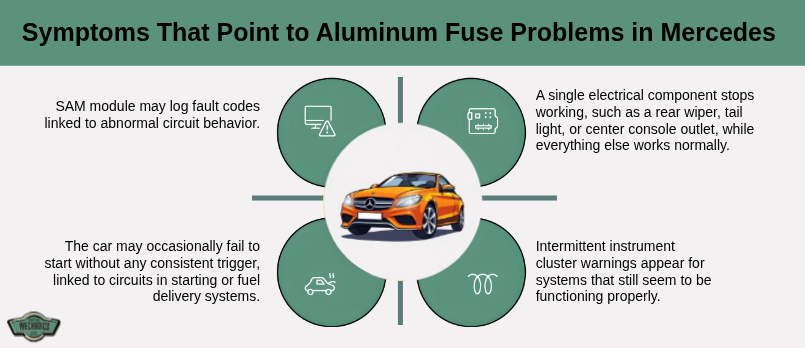
Because Mercedes SAM fuses control everything from exterior lighting and wipers to fuel pumps and windows, the symptoms of fuse failure are highly varied. Drivers often report a single electrical component that has stopped working — a rear wiper, a tail light, a center console outlet — while everything else functions normally. Intermittent instrument cluster warnings for systems that appear to be working is another telltale sign. Some Mercedes owners notice that their car fails to start occasionally without any consistent trigger, which can trace back to a fuse protecting a circuit in the starting or fuel delivery system. Because the SAM module logs fault codes when protected circuits behave abnormally, a professional scan with Mercedes-compatible diagnostic equipment is often the fastest path to identifying the failed fuse rather than a manual inspection of dozens of individual elements.
Professional Diagnosis and Repair at Master Mechanics
When a Mercedes arrives at our Kalamazoo shop with electrical gremlins, our first step is pulling fault codes from both SAM modules and any other control units showing flags. From there we can trace which circuit the fault belongs to and test fuse integrity with proper equipment. Aluminum fuses must be replaced with exact-specification components — using the wrong fuse rating or a non-OEM substitute can introduce new problems. We also inspect the fuse box contacts for oxidation or corrosion and address any moisture intrusion issues that may have contributed to the failure. Given that SAM-related repairs require careful electrical handling, we recommend against DIY fuse box work on Mercedes vehicles unless you’re fully familiar with the architecture.
Book Your Mercedes Electrical Diagnosis in Kalamazoo
Unexplained electrical failures in your Mercedes deserve a proper diagnosis, not guesswork. At Master Mechanics Auto Repair in Kalamazoo, our ASE-certified technicians have the Mercedes-specific tools to pinpoint fuse and SAM issues accurately. Call us at (269) 373-9000 or visit us at 3219 E Kilgore Rd, Kalamazoo, MI 49001 to schedule your appointment today.
Frequently Asked Questions
Q: Can I replace a Mercedes aluminum fuse myself?
A: While physically possible in some cases, it requires knowing the exact fuse specification and safely accessing the SAM box. We recommend professional service to avoid damaging control modules.
Q: How do I know if my Mercedes SAM module is the problem rather than the fuse?
A: A proper scan with Mercedes-compatible diagnostics will distinguish between a failed fuse and a damaged SAM. Symptoms can look identical from the driver’s seat.
Q: Will a blown fuse throw a warning light on my Mercedes?
A: Often yes, since many Mercedes systems perform self-diagnostics. However, some fuse failures produce no warning lights and only manifest as a non-functioning component.
Q: How long does a Mercedes fuse box diagnostic take?
A: Initial scanning and circuit testing typically takes one to two hours. Repair time depends on fuse accessibility and whether any related components were damaged.