
Quick Takeaways:
- Engine oil sludge forms when oil breaks down and its suspended byproducts precipitate as a tar-like deposit that blocks oil passages.
- Volkswagen 1.8T and 2.0T turbocharged engines are particularly prone to sludge when oil changes are delayed beyond 5,000-mile intervals.
- Kalamazoo’s cold winters and short-trip driving patterns on Stadium Drive and West Michigan Avenue accelerate sludge formation faster than highway-dominated driving.
- Signs of sludge include valve train ticking, low oil pressure warnings, and visible black deposits on the oil cap underside.
- Master Mechanics Auto Repair at 3219 E Kilgore Road provides Volkswagen engine inspection, oil flush evaluation, and sludge-related repair.
Kalamazoo has a specific driving pattern shaped by Western Michigan University, Kalamazoo College, the medical corridor along Howard Street, and the I-94 commute to Battle Creek and beyond. Short trips from neighborhoods like Vine and the Old West Side to downtown on Main Street or across Stadium Drive to the WMU campus — cold-start cycles that end before the engine reaches full operating temperature — are exactly the conditions that make VW turbocharged engines develop sludge faster than their owners realize. Master Mechanics Auto Repair at 3219 East Kilgore Road has been serving Kalamazoo and Portage since 1994 and sees the results of these driving patterns regularly in the engines of Volkswagen Jettas, Golfs, and Tiguans that come in with ticking valve trains and concerning oil condition readings.
What causes engine oil sludge to form in Volkswagen engines in Kalamazoo?
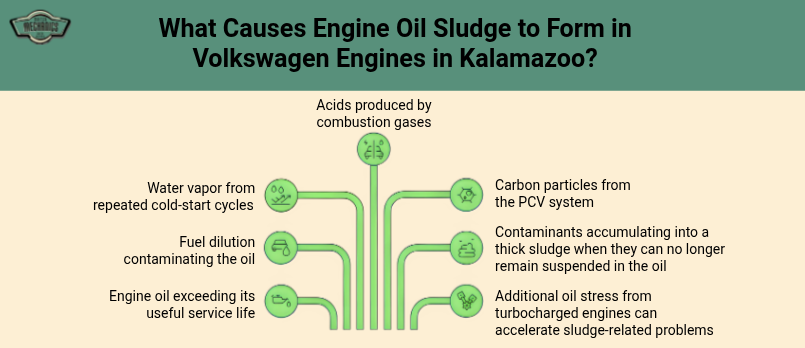
Engine oil sludge forms when oil exceeds its useful service life and the combustion byproducts — fuel dilution, water vapor from cold-start cycles, acids from combustion gases, and carbon particles from the PCV system — can no longer be held in suspension. At that point, they precipitate as a thick, tar-like gel that adheres to engine surfaces and progressively restricts oil flow.
VW’s 1.8T and 2.0T turbocharged engines are specifically sensitive because the turbocharger places additional demand on the oil. Sludge in the turbo oil supply line causes premature bearing failure — an expensive outcome that is entirely preventable with appropriate oil change frequency for Kalamazoo’s driving conditions. Schedule a Volkswagen engine inspection at Master Mechanics Auto Repair in Kalamazoo.
How does Kalamazoo’s winter driving accelerate sludge formation?
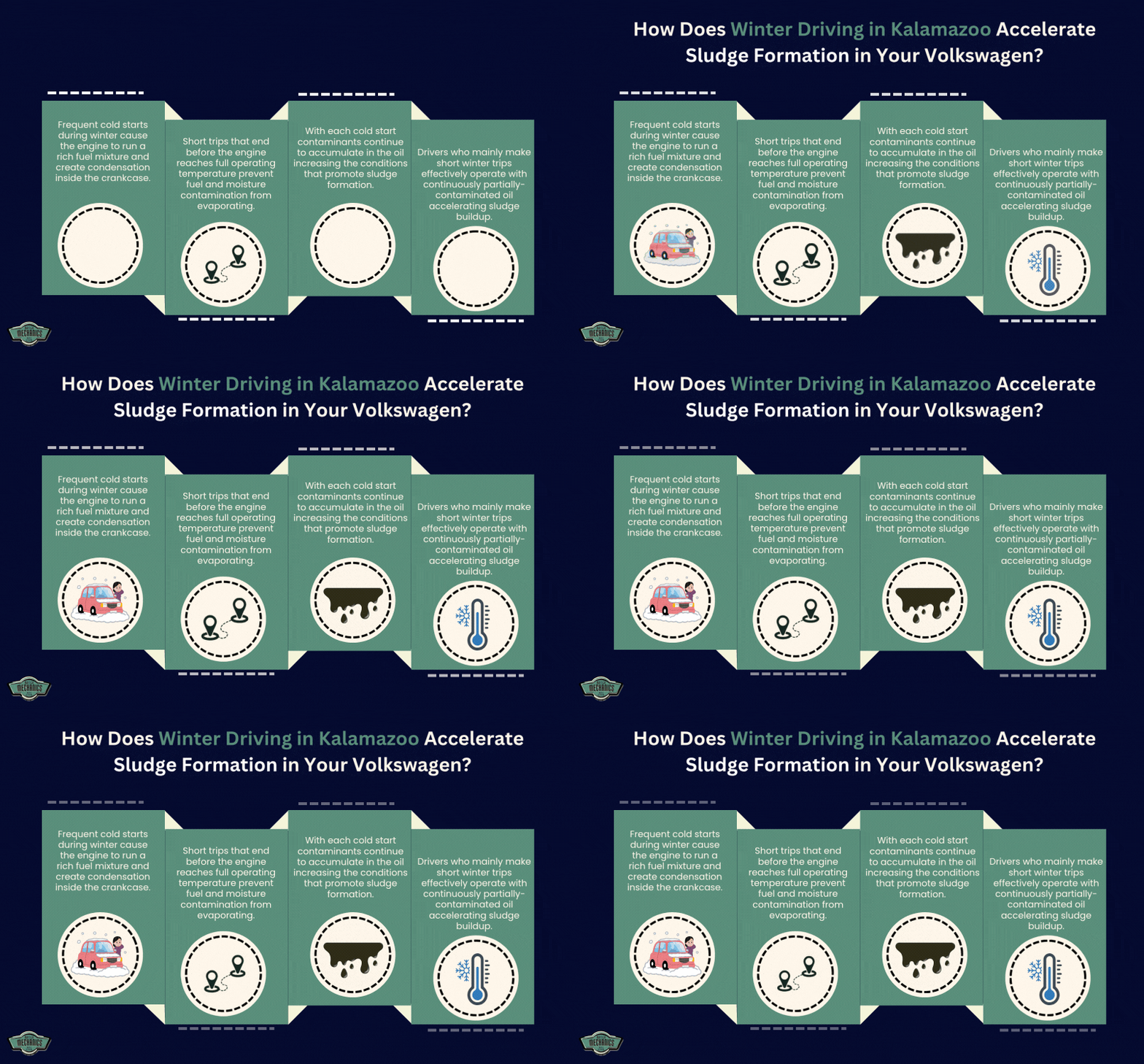
Cold-start cycles are the primary driver. When the engine starts cold on a January morning in Vine or the Westwood neighborhood, it runs a rich fuel mixture for the first several minutes and produces condensation inside the crankcase. Short trips that end before the engine reaches full operating temperature — the daily run from a neighborhood near WMU or Kalamazoo College down to the US-131 on-ramp — allow this contamination to accumulate with each cold start without the opportunity to evaporate.
A Kalamazoo VW owner making primarily short trips through winter is effectively running on continuously partially-contaminated oil. The practical response is to shorten oil change intervals well below what the car’s service monitor suggests during winter or for drivers with primarily short-trip patterns on Stadium Drive and Howard Street. Contact Master Mechanics Auto Repair in Kalamazoo about appropriate VW oil change intervals for your driving pattern.
What are the signs of oil sludge in a Kalamazoo Volkswagen?
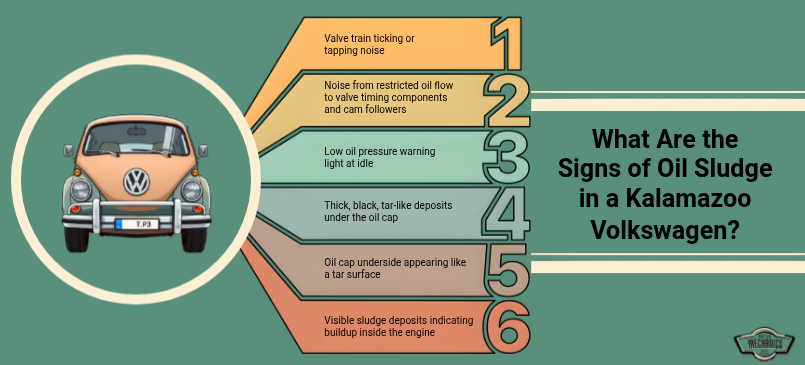
Early sludge buildup produces a valve train ticking or tapping sound — the VANOS variable valve timing system and hydraulic cam followers run on oil that passes through fine screens, and even partial sludge restriction causes them to run dry and produce noise. A low oil pressure warning light appearing at idle is a more serious sign that oil passages have significant restriction.
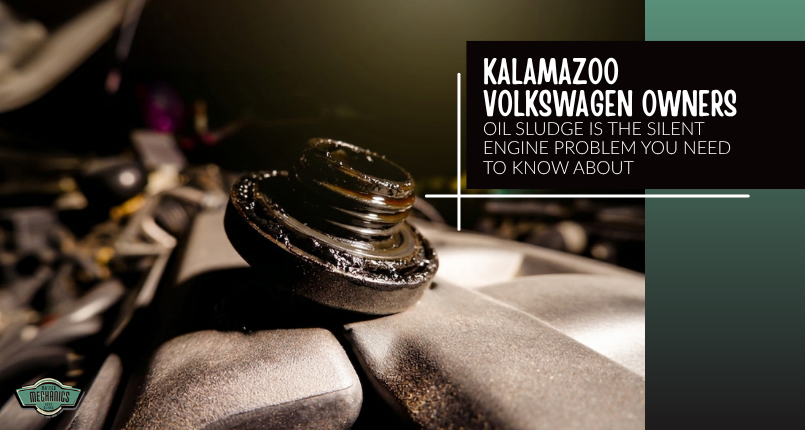
Removing the oil cap and looking at the underside tells a direct story. Clean oil leaves a golden-brown tint on the cap surface. Sludged oil leaves thick, black, tar-like deposits that are immediately visible. If the underside of your oil cap looks like a tar surface, the engine interior has sludge that needs to be addressed.
How does Master Mechanics address Volkswagen oil sludge in Kalamazoo?
The approach depends on the severity. Mild sludge — where deposits have not yet significantly restricted oil passages — can be addressed with a series of short-interval oil changes using high-quality detergent synthetic oil, combined with an engine flush additive used at the final drain interval before the change. Book your Volkswagen engine oil inspection at Master Mechanics Auto Repair in Kalamazoo.
Severe sludge — where oil passages are significantly restricted, oil pressure is affected, or VANOS components have suffered wear from oil starvation — requires inspection of the affected systems and may require mechanical cleaning of oil galleries. Master Mechanics provides a clear assessment of severity before recommending the repair approach.
Frequently Asked Questions
Q: Can sludge damage be reversed in a Volkswagen engine?
A: Mild to moderate sludge can often be reduced through repeated short-interval oil changes and flush treatments. Severe sludge that has caused oil passage restriction or damaged VANOS components requires mechanical intervention. The earlier the sludge is detected and addressed, the more likely it is that engine damage is minimal.
Q: Which Volkswagen models and engines are most prone to sludge in Kalamazoo?
A: The 1.8T and 2.0T TSI engines are the most commonly associated with sludge issues in cold-climate short-trip driving conditions. Master Mechanics at 3219 E Kilgore Road can assess any VW engine’s condition.
Q: How often should a Kalamazoo VW driver change oil to prevent sludge?
A: In primarily short-trip winter driving conditions on Kalamazoo’s city streets, every 3,500 to 5,000 miles is a practical guideline regardless of what the car’s service monitor indicates. The monitor is calibrated for balanced driving conditions — short-trip winter cycles accelerate oil degradation faster than it accounts for.
Q: Does Master Mechanics Auto Repair service other European brands besides Volkswagen?
A: Yes — Master Mechanics services Audi, BMW, Mercedes, and other European brands alongside Volkswagen in the Kalamazoo and Portage area. Contact the shop at (269) 373-9000 to confirm service availability.
Contact
Master Mechanics Auto Repair
3219 E Kilgore Rd, Kalamazoo, MI 49001
Phone: (269) 373-9000
Website: mastermechanicsauto.com
Hours: Mon-Fri 8:00 AM – 5:30 PM