
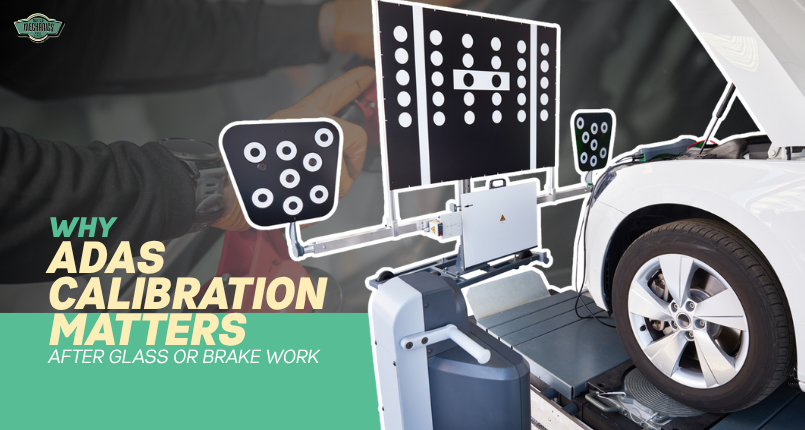
A rock off a gravel truck on I-94 costs you a windshield. The glass shop does clean work, the new one goes in, and the car looks perfect. But the forward camera behind that glass is now aimed slightly differently than it was, and nothing on the dash will tell you.
That camera runs your automatic emergency braking and lane keeping. Move its aim by a degree and the system’s picture of the road shifts by several feet at distance. Calibration is how we put it back, and it belongs on the invoice with the glass, the suspension work or the brake job.
Quick Summary: Key Takeaways
- Windshield replacement almost always requires camera recalibration: the forward camera mounts to the glass and its aim changes with it.
- Suspension and steering work matter too: thrust angle and ride height shift the reference points radar and cameras rely on.
- Small angles are big distances: a one-degree camera error becomes nearly two feet of error 100 feet down the road.
- The work needs space and software: a level floor, roughly 30 feet of clearance, factory targets and manufacturer scan tools.
- Budget $250 to $600 in most cases: far less than the crash the system exists to prevent.
ADAS sensors need recalibration any time their aim changes
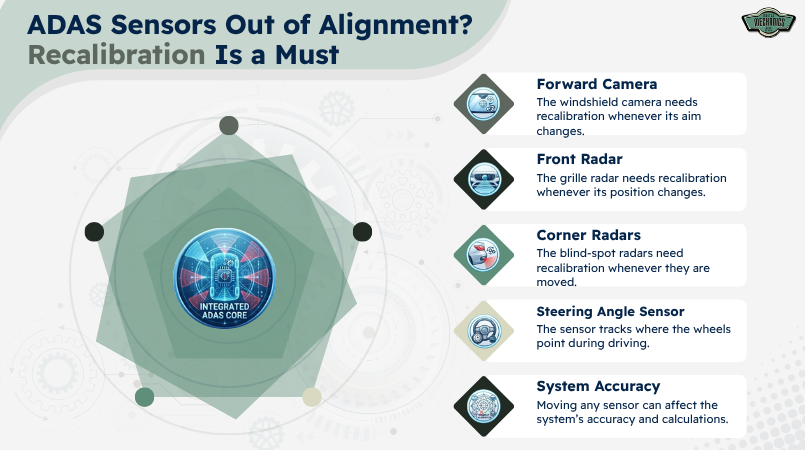
Calibration resets the system’s sense of straight ahead. Your car relies on a forward camera behind the windshield, radar in the grille, corner radars for blind-spot monitoring, and a steering angle sensor that reports where the wheels point. Move any of them and the math breaks.
No warning light appears. The computer has no way to know it’s wrong, so it trusts what the sensors report, aims the braking and steering assistance accordingly, and keeps doing so until somebody recalibrates it.
Windshield replacement is the most common trigger
Glass work heads the list. The camera bracket bonds to the windshield, and even a properly installed replacement sits at a marginally different angle or distance than the original because of urethane thickness, bracket position and glass curvature, and the camera’s field of view shifts with it. Every manufacturer calls for calibration after that job.
Aftermarket glass adds a wrinkle. Optical distortion in the camera’s viewing area can throw off lane detection even when the aim is right, which is one reason we prefer OEM or high-quality equivalent glass on ADAS-equipped vehicles.
Brake, steering and suspension work move the reference points
Anything that changes how the car sits or steers matters. A four-wheel alignment resets thrust angle and the steering angle sensor’s zero point, and replacing struts or springs changes ride height, which changes radar aim. Brake and wheel speed sensor work feeds the same stability data. It’s all one system.
That’s the argument for having the brake or suspension work and the calibration under one roof. Split them across two shops and the last one to touch the car inherits somebody else’s variables.
One degree of sensor error becomes feet of error down the road
The geometry is unforgiving. A camera off by a single degree misjudges lateral position by about 1.7 feet at 100 feet, which is the difference between reading a pedestrian at the curb and reading one in your lane. Automatic braking decides on exactly that data. Precision isn’t optional.
The safety payoff is documented. IIHS research on front crash prevention systems found that automatic emergency braking cut front-to-rear crashes roughly in half. A miscalibrated system gives up part of that benefit quietly.
Proper calibration takes floor space, targets and factory software
There are two types. Static calibration puts the car in front of printed targets at manufacturer-specified distances on a level floor with controlled lighting, and dynamic calibration requires driving at a set speed on well-marked road. Plenty of vehicles need both, in sequence.
Space is the part most shops can’t offer. Some procedures want 30 feet ahead of the vehicle and a floor that’s genuinely level. Add factory scan software and a set of targets, and you have the reason not every repair shop does this work.
Kalamazoo drivers get brake work and calibration in one visit
We do ADAS calibration in house on Kilgore Road. That means a brake job, suspension and steering work or a post-glass calibration gets completed and verified in one visit, on European, Asian and domestic vehicles alike, with documentation showing the system passed rather than a verbal assurance that it should be fine.
It matters here. Michigan roads chew up suspension parts, deer season makes automatic braking genuinely useful on US-131, and Battle Creek and Portage customers drive highway miles every day. Ask us about calibration before you approve any glass or suspension work.
Frequently Asked Questions
Q: Does a windshield replacement require ADAS calibration?
A: On nearly every vehicle with a forward-facing camera, yes. The camera mounts to the glass, so its aim changes when the glass does. Manufacturers specify calibration as part of the procedure, and skipping it leaves lane keeping and automatic braking working from bad data.
Q: Do I need ADAS calibration after an alignment?
A: Often yes. An alignment changes thrust angle and the steering angle sensor’s zero point, which lane keeping and adaptive cruise use as reference. We check the manufacturer’s requirement for your specific vehicle rather than assuming.
Q: How do I know if my car’s safety systems are out of calibration?
A: Sometimes a warning appears, but often nothing does. Watch for lane keeping that tugs toward one side, adaptive cruise that brakes late or early, or blind-spot alerts that fire at nothing. A scan and calibration check settles it.
Schedule an ADAS calibration check in Kalamazoo
If your car had glass, alignment, suspension or brake work in the last year and nobody mentioned calibration, bring it in. We’ll scan the systems and tell you exactly what needs setting.
Master Mechanics — 3219 E Kilgore Rd, Kalamazoo, MI 49001
Hours: Mon–Fri 8:00 AM–5:30 PM; Sat–Sun closed
Website: mastermechanicsauto.com