
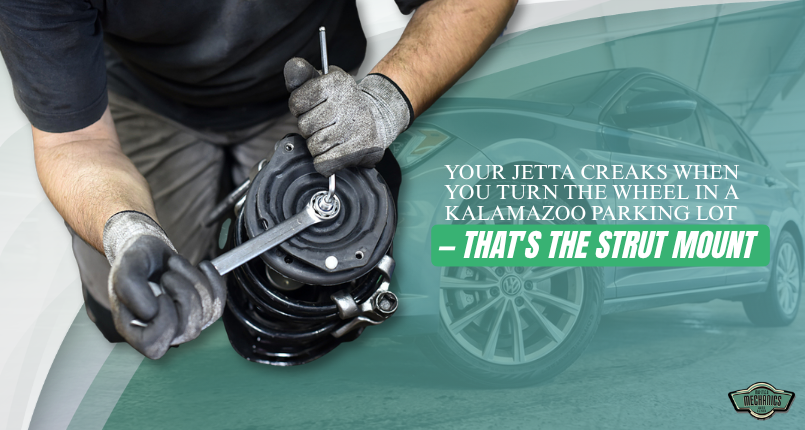
It is loudest at 2 mph. You crank the wheel to back out of a space on East Kilgore Road and the front of the car answers with a creak, or a pop, or a sound like someone twisting a plastic bottle. Out on the road it disappears. In the parking lot it happens every single time.
That is a failed strut mount — specifically the bearing inside it — and on a Volkswagen it is one of the most common suspension complaints we see once Kalamazoo mornings drop below freezing. It is not dangerous today. It does change how the car steers, and it gets worse from here.
Quick Summary: Key Takeaways
- What the mount does: It bolts the top of the strut to the body through a rubber isolator and a bearing that lets the whole strut rotate when you steer.
- The signature symptom: A creak, groan or pop when turning the wheel at very low speed, worst on cold mornings.
- Second symptom: A clunk over bumps and a steering wheel that feels notchy or wants to snap back to center unevenly.
- Michigan is hard on them: Freeze-thaw pavement pounds the isolator, and salt water gets into the bearing from above.
- Replace with the strut: The strut has to come out anyway, so doing the mount alone twice is the expensive way to save money.
The strut mount is the bearing your front suspension steers on
Look at the top of a front strut and you will find a plate bolted to the body, a thick rubber isolator, and a bearing sandwiched between them. The isolator absorbs road impact before it reaches the shell. The bearing lets the strut and spring rotate as a unit when you turn the wheel.
Two parts, two failure modes. Rubber cracks and separates, and you get a clunk over bumps. The bearing dries out or corrodes, and you get the creak. Cold makes both worse.
On the Volkswagens we see most in Kalamazoo — Jetta, Passat, Golf and Tiguan — the bearing usually goes first. Water enters from the top, sits in the recess where the mount lives, and the bearing never dries out again.
Cold mornings and low speeds are when it talks
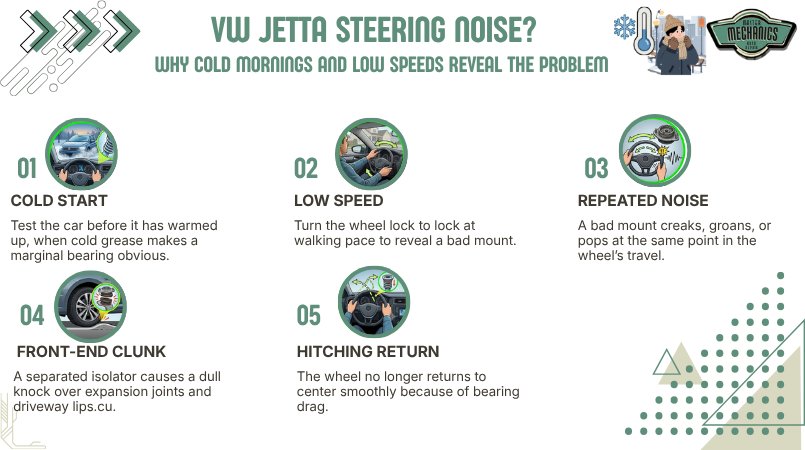
The test takes ten seconds: park, roll the windows down, and turn the wheel lock to lock at walking pace. A bad mount will creak, groan or pop, and it will do it at the same point in the wheel’s travel every time. Try it before the car has warmed up, because cold grease makes a marginal bearing obvious.
The clunk is the other half. A separated isolator lets the strut top shift against the body, so a single dull knock arrives over expansion joints and driveway lips, and it sounds like it is coming from inside the front fender rather than from underneath the car.
One more clue: the wheel no longer returns to center smoothly. It hitches. That is bearing drag, not power steering.
Southwest Michigan’s freeze-thaw calendar is what kills them
The mount takes the sharpest hit of any suspension component because it sits at the top of the load path. Every pothole edge on I-94 sends that impact through the strut and into a rubber isolator, and by late October the freeze-thaw cycle that breaks pavement apart around here is running most weeks.
The pavement numbers are not kind. ASCE’s Michigan infrastructure fact sheet rates 40% of the state’s roads as being in poor or fair condition, and the additional vehicle operating cost from deteriorated roads reached $725 per motorist nationally in 2023 in ASCE’s roads assessment.
Then the brine trucks come out. Salt water runs down the windshield, into the cowl, and straight onto the strut mount recess, where it does exactly what you would expect to a bearing.
A worn mount changes how the car steers, not just how it sounds
A collapsed isolator lets the top of the strut sit slightly off where the engineers put it, which shifts camber and caster on that corner. The car pulls. The tire wears on one shoulder, and the steering never quite settles at highway speed.
There is also a diagnosis trap here. Creaks and clunks from the front of a car get blamed on brakes constantly, and worn brake hardware can rattle over bumps in a similar way. If your noise happens under braking rather than under steering, that is a different job.
And left long enough, a failing bearing chews the spring seat and the upper insulator too. Small part, bigger bill.
How we test mounts before recommending struts
We start with the steering test and a stethoscope on the strut tower, then load the suspension on a lift and watch the mount for movement. A separated isolator is visible. A dry bearing you feel by hand.
If the strut itself is still holding oil and the mount is the only failure, we say so. Where both are tired — which is common past 100,000 Michigan miles — we replace them together, because pulling the strut twice costs you double the labor for no reason. We have been fixing cars for Kalamazoo drivers for decades, with ASE-certified technicians across European, Asian and domestic makes.
Frequently Asked Questions
Q: Why does my VW creak when I turn the steering wheel at low speed?
A: The strut mount bearing is the usual answer. It lets the strut rotate when you steer, and once it dries out or corrodes it binds and releases in steps, which you hear as a creak or pop. Cold weather makes it much more obvious.
Q: Can I drive with a bad strut mount?
A: For a while, yes, but do not let it run all winter. The noise is harmless; the geometry change is not. A collapsed mount alters camber slightly, wears a front tire unevenly, and eventually damages the spring seat above it.
Q: Should strut mounts be replaced in pairs?
A: We recommend it on the front axle. Both sides are the same age and have seen the same salt, so replacing one leaves the car with mismatched ride height and a second visit a few months out. Rear mounts follow the same logic.
Get the creak diagnosed before the salt starts
A strut mount in October is a straightforward job with clean bolts. The same repair in February means fighting corrosion on every fastener. Bring the car in, turn the wheel for us, and we will tell you which corner it is.
Master Mechanics – 3219 E Kilgore Rd, Kalamazoo, MI 49001
Hours: Mon-Fri 8:00 AM to 5:30 PM; closed Saturday and Sunday
Website: mastermechanicsauto.com