

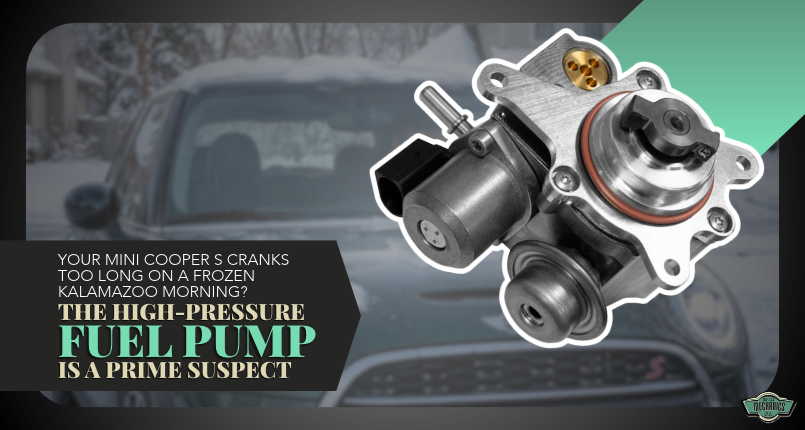
A MINI Cooper S should fire almost the moment you press the start button. When an R56-family car (the R55 through R61 Cooper S models) cranks and cranks, suspect the MINI Cooper high pressure fuel pump early. A worn pump struggles to build pressure on a cold start, though it isn’t the only part that can cause a long crank. Kalamazoo mornings drop below freezing from November on, and that’s when weak starts turn into no-starts, usually right before a holiday drive down I-94 toward Chicago or Detroit.
Quick Summary: Key Takeaways
- The pump builds injection pressure: a worn high-pressure pump shows up first as a long crank, a cold stumble or a loss of power.
- MINI has extended pump coverage before: 2011 and 2012 Cooper S models with the N18 engine got a 10-year/120,000-mile pump warranty, which has now run out on nearly every car.
- Rule out the coolant sensor: MINI’s own bulletin ties cold long cranks on R55 to R61 Cooper S models to the coolant temperature sensor and thermostat.
- Test before replacing: a pump this expensive should be confirmed by pressure readings, not by symptoms alone.
What the MINI Cooper High Pressure Fuel Pump Does
The high-pressure pump is driven by the engine. An electric pump in the tank feeds it at ordinary fuel-line pressure, and it raises that to the much higher pressure a direct-injection engine needs. When it wears, it can’t build that pressure quickly enough, so the starter keeps turning the engine over while the computer waits for the fuel rail to reach the pressure it needs to fire.
So a failing MINI Cooper S fuel pump shows up at startup first. A long crank is the early sign. Later come a stumble on cold acceleration, flat power when you merge onto US-131, and a check engine light with fuel pressure faults stored.
Cold Mornings Make a Weak Pump Obvious
Cold makes everything harder for a tired pump. A Cooper S that started fine through September may need a second try, and then a third, once the car sits outside overnight in late November.
Then there’s the stumble. If the car hesitates for the first minute or two of a cold drive and then smooths out, low fuel pressure is a strong candidate. Dirty injectors feel similar. So does a failing throttle position sensor, which is why the shop’s earlier post on MINI stumbles is worth reading before anyone orders parts.
A Long Crank Isn’t Always the Fuel Pump
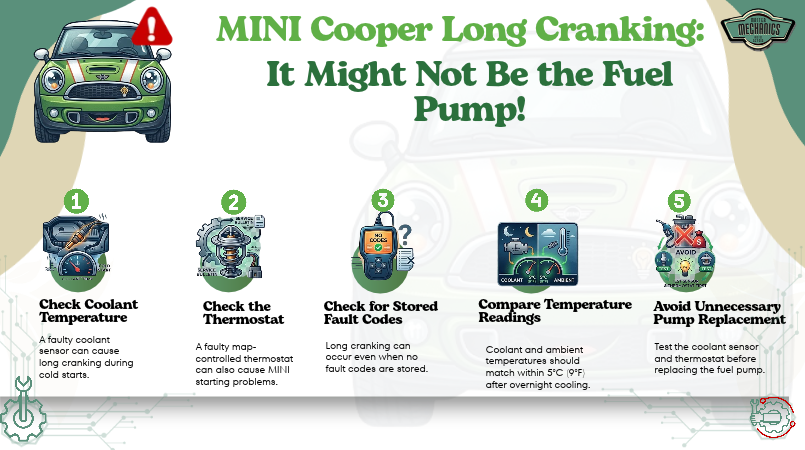
Check the coolant temperature reading first. MINI service bulletin SI M17 01 15, revised in July 2018 for R55 through R61 Cooper S models, describes a long crank on a cold engine with no fault codes stored. It traces the cause to the coolant temperature sensor or the map-controlled thermostat, not the fuel pump.
The test is simple. After a night outside, the engine computer’s coolant temperature and the ambient air temperature should agree within 5°C, which is 9°F. A sensor that reports a warm engine on a frozen Kalamazoo morning gives the computer the wrong starting point, and ruling it out first can save you the price of a pump that was never the problem.
The 10-Year Pump Warranty Extension Has Run Out
MINI has dealt with these pumps before. In 2016, MINI extended the high-pressure fuel pump warranty on 2011 and 2012 Cooper S models with the N18 engine to 10 years or 120,000 miles, for cars built up to February 29, 2012. Later cars got different equipment.
Ten years from a 2011 or 2012 in-service date has now passed. The cost is yours now. If your MINI Cooper fuel pump was already replaced under that program, dig out the invoice, because that replacement pump has its own years and miles on it by now and is no longer the fresh part it once was. BMW owners run into high-pressure pump failures as well, and the shop covers those separately.
How the Pump Gets Confirmed Before It’s Replaced
Pressure readings decide it. MINI’s own warranty bulletin lists a full vehicle test with a diagnosis system, battery support during testing and a delivery pressure check before the pump comes off, and that order makes sense for any car.
Look wider first. A sound diagnosis checks the in-tank pump, the high-pressure side, the coolant sensor and the battery before a part is quoted. Master Mechanics’ technicians are ASE certified, the shop keeps factory-grade diagnostic equipment for European makes including MINI, and the shop goes over what it finds with you before you decide on a repair. Won’t start at all? Stop cranking a cold battery. The shop’s towing page points to Graham’s Towing.
Frequently Asked Questions
Q: What are the symptoms of a bad high pressure fuel pump on a MINI Cooper S?
A: A long crank on a cold start comes first. After that, expect a cold stumble, flat acceleration and a check engine light with fuel pressure faults stored.
Q: Can I drive my MINI Cooper with a failing high pressure fuel pump?
A: Not for long. Low pressure can stall the engine in traffic, and a car that barely starts in November will strand you in January.
Q: Is the MINI Cooper high pressure fuel pump still under warranty?
A: For nearly every car, no. MINI’s extension covered 2011 and 2012 N18 Cooper S models for 10 years or 120,000 miles from the in-service date, and that window has closed.
Get the Pump Tested Before the Deep Freeze
Count the cranks for a week. Note the overnight low each time and whether the car stumbled once it caught, because a pattern that tracks the thermometer points one way and a random one points another. Pressure readings taken while the car still starts on its own beat readings from a car that arrived on a tow truck. Bring the log along. The car goes to 3219 E Kilgore Rd, Kalamazoo, MI 49001; for the shop’s other MINI work, see mastermechanicsauto.com.