

State and local agencies spend more than 2.3 billion dollars a year on snow and ice control, according to the Federal Highway Administration. Most of that ends up as brine on the road, and a fair share of it ends up on the underside of your car. By the second or third Michigan winter it is working on the one part of the electrical system almost nobody thinks about: the ground connections.
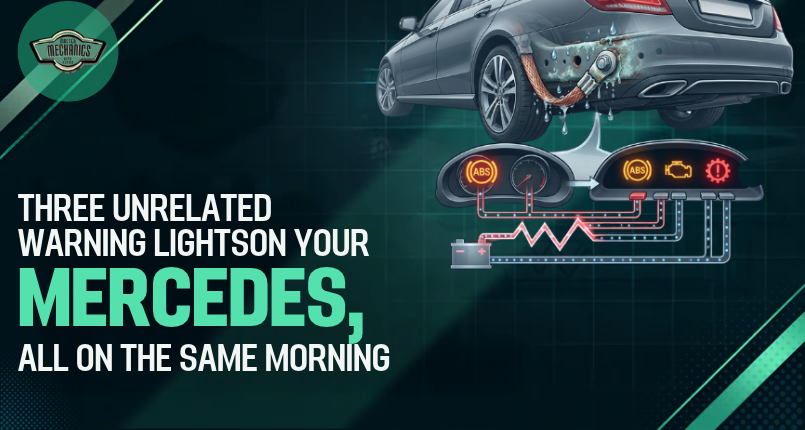
A Mercedes that suddenly reports an ABS fault, a transmission message and a dead power mirror in the same week usually has one corroded ground behind all three.
Quick Summary: Key Takeaways
- Current needs a return path: every circuit grounds to the body or engine, and corrosion raises resistance on all of them at once.
- Salt is the accelerant: brine wicks into crimps and bolted joints, then sits there through the thaw.
- The symptoms look unrelated: that scatter is the clue.
- A voltage drop test finds it: not a code reader, and not a parts swap.
- The repair is usually cheap: cleaning and re-terminating a ground strap costs a fraction of the modules people replace instead.
Electricity has to get back, and salt is in the way
A circuit is a loop. Power leaves the battery, does its job at the headlight or the fuel pump, and returns through a ground strap bolted to the body or the engine block. Those bolted joints are steel against aluminum against copper, out in the weather, three inches above a road that has been salted since Thanksgiving.
Brine gets into the crimp where the wire meets the terminal. It corrodes from the inside out, so the strap looks perfectly healthy and still measures badly. Resistance climbs by a fraction of an ohm, and that sounds like nothing until you remember what runs through it. A starter pulls two hundred amps. At that current even a hundredth of an ohm in the return path eats two volts, and nothing downstream works properly once it does.
The strange part is how selective it is. A ground serving the rear of the car affects the fuel pump, the tail lights and the parking sensors, and leaves everything forward of the B-pillar untouched. Owners describe it as the car being haunted. It is just one bolt.
Temperature makes it worse in a way that explains a lot of the complaints we hear. Metal contracts in the cold, so a joint that is already marginal opens up a fraction further on a January morning and closes again by afternoon. These are the faults that vanish the moment you book the car in.
Why the scan tool sends people down the wrong road
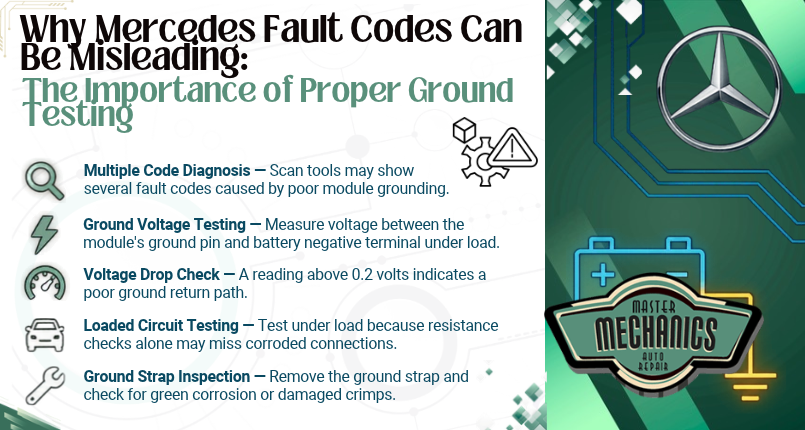
Plug in a reader and you get codes from four modules. Every one of them is real, and every one of them describes a symptom. A control unit that cannot pull its ground properly reports low supply voltage, implausible sensor values or a loss of communication, and all three of those read like component failures.
So the car gets a wheel speed sensor it did not need, then a module, then the owner is told the wiring harness is shot. The actual test takes ten minutes. With the circuit loaded, you measure the voltage difference between the module’s ground pin and the battery’s negative post. Anything above about two tenths of a volt means the return path is bad, and the number tells you how bad.
Resistance alone will not catch it. A corroded joint can read close to zero ohms on a meter that pushes a few milliamps through it and still collapse the moment two hundred amps try to pass. Testing under load is the whole point, and it is why a quick continuity check at the counter so often declares a bad ground perfectly healthy.
From there it is a matter of walking the strap back to its bolt, undoing it, and looking at what the salt did. Green powder on the lug and a crumbling crimp is the whole diagnosis.
What it takes to stop it coming back
Cleaning a corroded ground and bolting it straight back down buys a season. Doing it properly means cutting back the wire to clean copper, fitting a new terminal, taking the paint and rust off the body contact face, torquing the bolt and then sealing the joint so brine cannot get in again.
It also pays to check the others while the car is on the lift, because the strap that failed is rarely the only one that spent six winters in the same conditions. Doing the whole set in one visit is cheaper than coming back for each in turn.
A wash matters more than people expect. Salt left on the underside keeps attracting moisture out of the air long after the roads have dried, so the chemistry carries on through every thaw. Rinsing the underbody when the temperature allows it is unglamorous, and it does more for the electrical system over ten years than any product sold in a spray can.
One last habit worth adopting: if the car has ever been jump started, check the ground point that was used. A clamp bitten onto a painted bracket arcs, pits the surface and leaves a joint that was fine last year and is not fine now.
Let Us Find the Bolt Instead of Replacing the Module
If your Mercedes has started reporting faults that have no business being related, have the grounds measured before anyone orders parts. The shop is at 3219 E Kilgore Rd in Kalamazoo, and the rest of what we handle is listed at mastermechanicsauto.com.